

Create a Review Pipeline for Every Draft You Submit
In this edition of thesify Weekly, you will turn scattered feedback into a simple, repeatable review pipeline for each article, chapter, or grant. You will map 4 to 6 checkpoints from first idea to decision letter, decide who should read what at each stage, and see how to scale the pipeline up or down for different projects. The companion blog, What Authors Need to Know About Pre-Submission Review vs Peer Review, shows how pre-submission review and peer review serve different purposes, so you can place each stage in the right part of your own pipeline.
This Week’s thesify Feature to Try: Start With High Impact Recommendation #1
If you only have time to fix one thing before submission, start with High Impact recommendation #1 in thesify’s Feedback panel. This is the single change that will move your draft the furthest, usually by tightening your thesis, clarifying your main claim, or sharpening how you frame the project.
Instead of skimming all the feedback and feeling overwhelmed, treat High Impact recommendation #1 as your one non-negotiable revision task.

High Impact recommendation 1 asks the writer to sharpen the thesis and make the implications for trust in healthcare explicit.
What High Impact Recommendation #1 Does
Picks out the most important problem in your draft at this stage, so you know exactly where to begin.
Explains why the change matters for readers or reviewers, not only what to change.
Gives guidance that usually affects several sections at once, instead of tiny line edits.

In another project, High Impact recommendation 1 focuses on clarifying mechanisms and implications in a thesis about illegal drug use.
How To Use High Impact Recommendation #1 When You Have Limited Time
Run a review in thesify and open Feedback.
Upload your document, run the analysis, then open the Feedback tab on the right.
Go straight to High Impact recommendation #1.
In the Recommendations section, find the High Impact list and click Recommendation 1. Read it slowly once, without editing.

A third example of High Impact recommendation 1, guiding the writer to define key terms and add context when comparing mental and somatic disorders.
Underline the core ask.
Rewrite the recommendation in your own words in one short sentence. For example:
“Clarify what I am comparing and why it matters.”
“State the mechanisms and implications, not only the observation.”
Mark the key places in your draft.
Identify two or three locations where this recommendation matters most, usually:
Your thesis in the introduction
A key paragraph in the discussion or argument
Your abstract or conclusion
Do one focused pass only for recommendation #1.
Revise the marked sections with that single goal. Ignore other issues for now. After editing, reread the recommendation and check that your changes actually match what it is asking.
Use Chat with Theo if you feel stuck.
If you are unsure how to implement the advice, scroll to the bottom of the Feedback panel and open Chat with Theo. Copy High Impact recommendation #1 into the chat and ask for something concrete, for example:
“Can you suggest three revised thesis statements that follow this advice?”
“Show me an example paragraph that applies this advice to my introduction.”
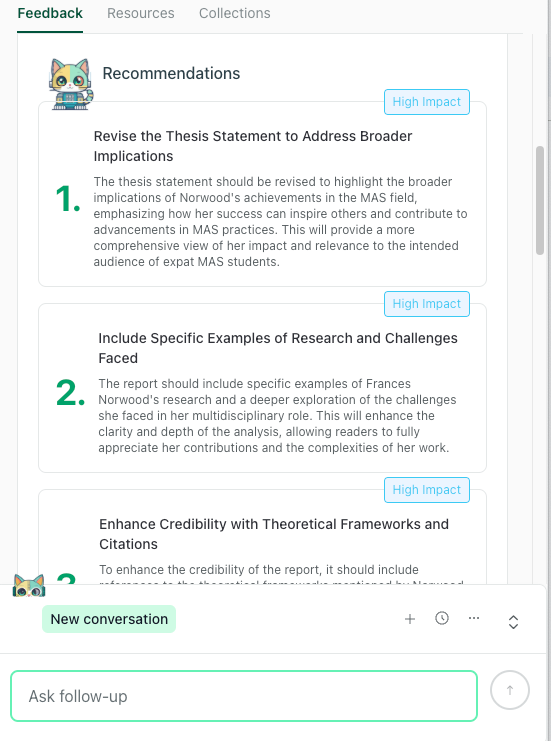
High Impact recommendations appear as a numbered list in thesify’s Feedback panel, with Chat with Theo at the bottom for follow-up questions.
Stop once recommendation #1 is truly done.
Even if you do nothing else that day, completing High Impact recommendation #1 will usually make your manuscript noticeably clearer and easier to review.
Your Weekly Tips: Build A Review Ladder You Can Reuse
1. Sketch 4 To 6 Checkpoints For One Real Project
Take one current article, chapter, or grant and write a simple ladder for it on one page. For example:
Idea and scope check
Section outline
First full draft
Pre-submission review
Submission
Post-review revision
Adjust labels so they match how you actually work. The goal is clarity, not perfection.
2. Assign A Reviewer Or Tool To Each Stage
For every checkpoint, decide who or what looks at the work and what you want from them. For example:
Idea and scope: colleague or supervisor, asked only, “Is this worth pursuing for this journal or call?”
Outline: peer who is good at structure, or thesify to check flow and missing links.
Pre-submission review: thesify plus one trusted reader, with questions like, “Where is the thesis unclear?” or “Which section feels weakest?”
Keep it to two or three focused questions per stage so people know how to help you.
3. Turn Your Ladder Into A Calendar
Start from your external deadline and work backwards. Assign each checkpoint:
A target date
One or two time blocks in your actual schedule
Any “lead time” you need from readers
For example, you might block one week for the first full draft, then ask a co-author to read it by a specific date, then reserve a separate slot to process their comments. Treat these review points as real tasks, not optional extras.
4. Decide What You Revise First At Each Stage
For each checkpoint, write down one or two “must-do” items so you always know what to tackle first. A simple pattern is:
Early stages: focus on thesis, contribution, and section order.
Middle stages: strengthen evidence, examples, and links between paragraphs.
Late stages: tighten language, format references, and fix small inconsistencies.
If you use thesify, let the most important feedback (such as High Impact recommendation 1) define your top task for that stage. This keeps every pass targeted and makes the pipeline easy to reuse for your next project.
This Week at thesify: Shape Our Next Steps
We are running a very short survey, around three minutes, to learn who you are, what you study, and how you actually handle reading and writing tasks. Your answers help us decide which features to build first, which examples to write, and how thesify should behave for different roles, from bachelor’s students to faculty.
This Week’s Blog: Pre-Submission Review vs Peer Review: A Guide for Authors
Our latest blog, Pre-Submission Review vs Peer Review: A Guide for Authors, explains why pre-submission review is not a shortcut to peer review, and why that is a strength. You will see what editors and peer reviewers focus on, how pre-submission checks differ in purpose, and how to use them together so your manuscript arrives in peer review with fewer preventable problems.
Related Resources
thesify Weekly Newsletter Archive: Treat the archive as your on-demand skills library for research and writing. Each issue offers a compact toolkit around one step in the process, such as narrowing a topic, planning sections, managing sources, or integrating AI transparently. You can open a single edition when you need a targeted fix, or follow a short run of related issues to upgrade a bigger part of your workflow with concrete prompts, checklists, and examples.ready-to-use questions and checklists.
From Feedback to Revision Plan: Chat with Theo Guide: Many academics are curious about AI tools that can chat with their PDF or draft, but currently most tools summarize or answer questions without focusing on writing quality or pedagogy. Chat with Theo, however, offers structure-aware chat that can discuss your actual draft’s argument flow or methodology. Learn how to use Theo’s unique ability to engage with your entire document (draft + feedback + paper digest) – e.g. asking “Does my literature review have gaps?” or “What does the digest say about related work?” – with examples of how Theo highlights structural issues or answers content questions.
How to Use thesify’s Downloadable Feedback Report for Pre‑Submission Success: Learn how to tackle the challenge of managing revisions in academic writing, especially when feedback is scattered across emails or multiple reviewers. Having a structured AI feedback report PDF solves the problems of version control and collaboration. Find out why AI writing feedback for researchers and shareable feedback matters. Plus get step-by-step directions on how to generate a downloadable feedback report in thesify and how to use this shareable manuscript feedback.
How to Improve Your Thesis Chapters: 7-Step AI Feedback Guide: In your revision plan, it’s important to take a structured approach to revisions. This article will serve anyone who wants a thorough, stepwise method, and explain how thesify aids in planning revisions. You’ll get sound writing advice on how to ensure your thesis statement is strong. Plus, we cover thesis chapter structure showing how to organize and structure each chapter logically to improve readability and coherence. Before you hit submit, run through our final thesis checklist: proofreading, formatting, and integrity.
Try thesify’s Feedback and Export Your Own Report
If you want to transform your academic writing process—receiving clear, actionable feedback, discovering new research avenues and chatting with an AI mentor—upgrade today. Responsible AI tools like thesify help you improve your writing without compromising integrity.
Need more insights? Visit our full blog archive or newsletter archive for expert advice on academic writing.
Until next time,
The thesify Team