

tW: Clear Rules for AI Edge Cases
Defensible tests for AI gray zones so you know when paraphrasing, summaries, templates, or transcript cleanup stay on the right side of policy.
Edge Cases You Actually Hit: Clear Rules For AI Support
This edition of thesify Weekly, you will get clear, defensible rules for the AI edge cases you hit every week, including paraphrasing your own text, summarizing sources, using templates, and cleaning transcripts. Instead of guessing what is acceptable, you will leave with simple yes or no checks you can apply before you ask an AI tool to help. This week’s blog also walks you through the best AI tools to improve academic writing in 2026, so you can decide which ones belong in your workflow and how to use them without creating new integrity risks.
This Week’s thesify Feature to Try: Grant Suggestions
Use thesify’s grant suggestions to turn a rough idea into a shortlist of concrete calls that actually fit your project, deadlines, and region.
What it does
Reads your current document or project description and surfaces relevant grants.
Shows a match score, opening date, deadline, and short description for each call, so you can scan quickly.
Links you straight to the official call page and lets you save promising items into a collection for later.
If you already have a draft proposal, you can also opt in to try thesify’s beta grant reviewer to get structured feedback on how clearly you answer the call.
How to use it
Open your current project in thesify. This can be a paper, proposal sketch, or concept note.
In the right sidebar, click Resources, then select the Grants tab.
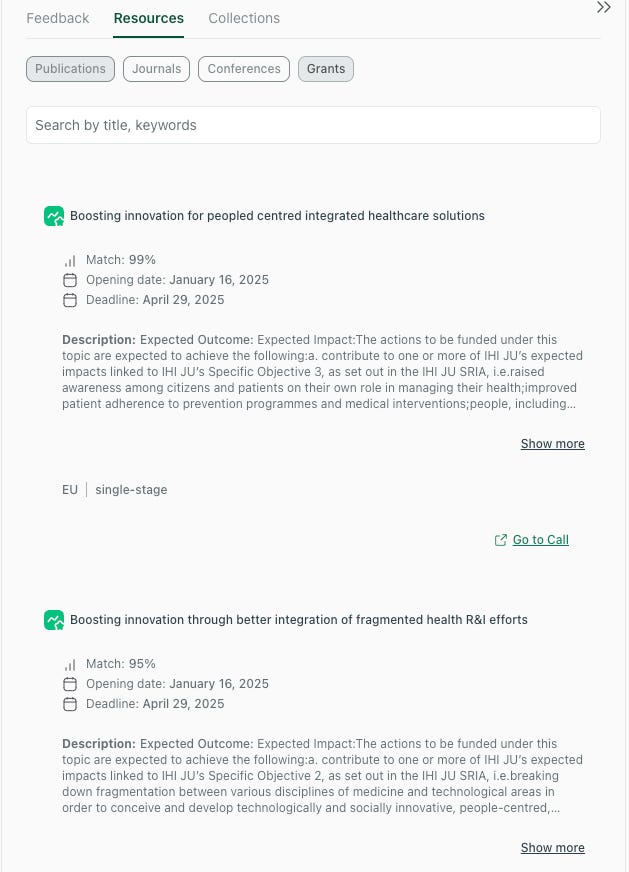
Scan grant matches with key dates and match scores directly beside your draft.
Browse the suggested calls. Use the match percentage, opening date, and deadline to decide which ones are realistic for you.
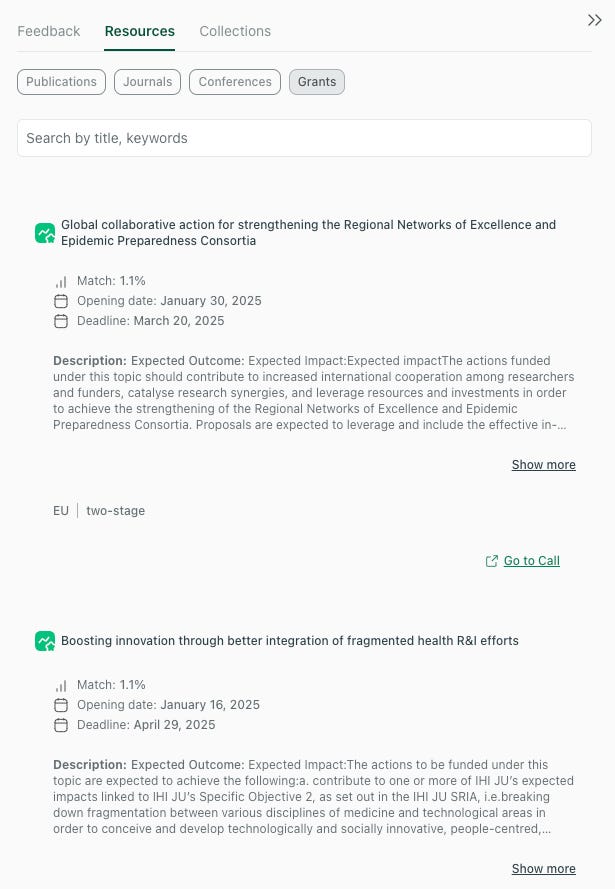
Open the Grants tab to compare scope, impact, and timing for each call.
Click Show more to read the expected outcomes and scope, then use Go to Call to open the official call page in your browser.
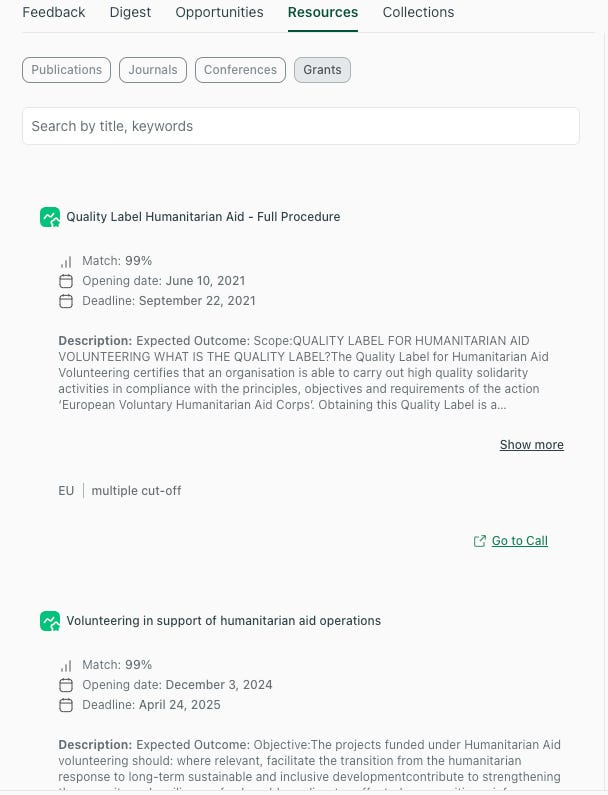
Find high-match humanitarian aid and volunteering calls, including deadlines and direct links to the official call page, right beside your draft.
When a call looks promising, add it to a collection so you can compare options as your project evolves.
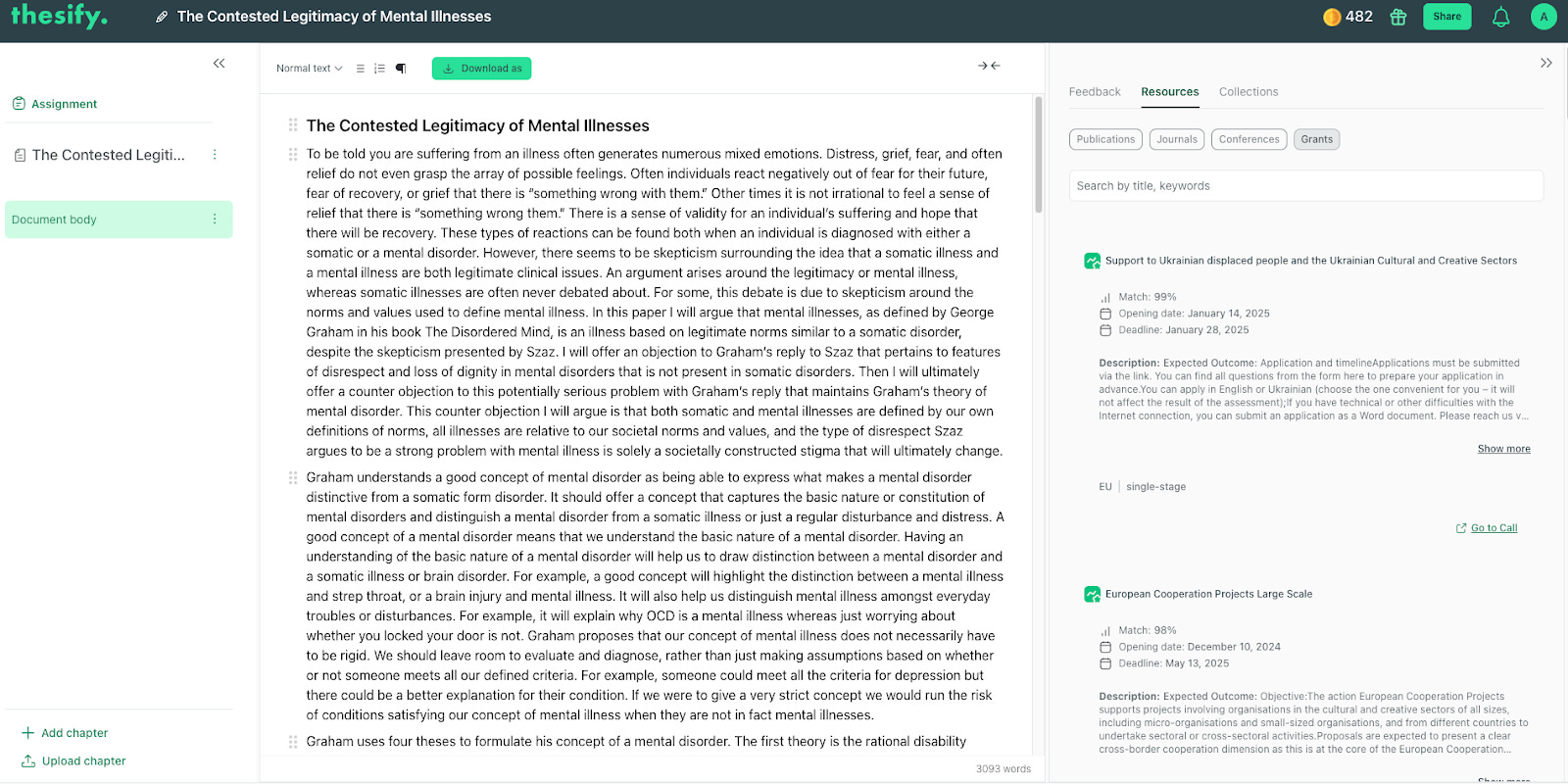
View funding and venue suggestions in context while you write.
Your Weekly Tips: Clear Calls on AI Edge Cases
1. Paraphrasing Your Own Text Without Losing Ownership
Use AI to sharpen wording, not to replace your thinking.
Good use: paste a paragraph you already drafted and ask for a clearer version that keeps all the same points and structure.
Higher-risk use: pasting only bullet points and asking for a full paragraph or section. At that point the model is generating claims and prose you did not write.
Quick test: if you could defend the passage as “my own writing, just edited for clarity,” it is closer to paraphrasing. If the tool is filling in missing reasoning or adding new examples, you are in ghostwriter territory.
2. Summarizing Sources vs Generating “Summaries”
Summarizing a source is about showing that you read it. AI can help, but only if the reading still happens.
Safer pattern: upload the article, ask for a structured outline of sections, then reread the original and write your own synthesis using that outline as a checklist. See the below example, of thesify’s PaperDigest as a safe example:
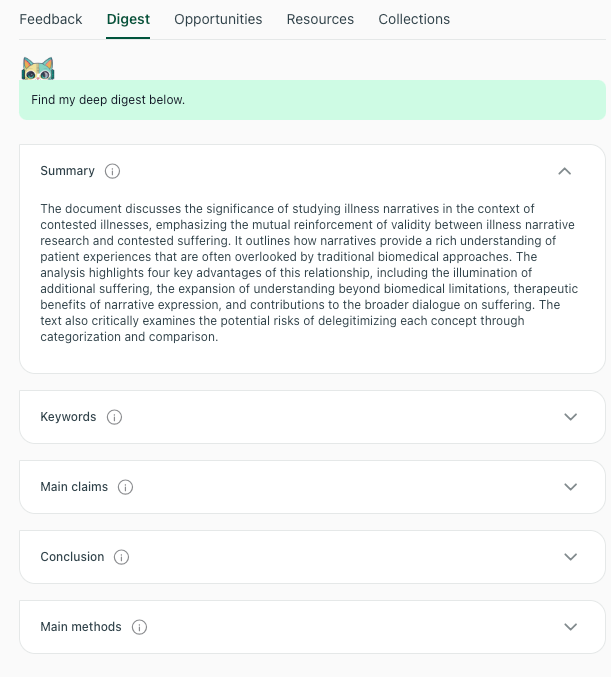
A digest like this is helpful once you have read the article and want a structured scaffold for your own summary.
Risky pattern: ask the model for “a summary of Author X, 2022” without uploading the PDF, then quote that summary directly in your paper. You cannot know if it is accurate or complete.
A simple rule: you can use AI to organize what you have already read, but the sentences that interpret a source for your reader should still come from you.
3. Template Writing vs Claim Writing
Templates save time on repetitive scaffolding. Problems start when templates slide into finished arguments.
Safe examples: section headers, a structured outline for a literature review, or a neutral template for describing datasets and methods.
Unsafe examples: asking the model to “write my contribution section” or “draft limitations for this study” without you providing specific points. That shifts authorship of key claims to the tool.
Treat templates as empty containers. Fill them with your own sentences about what you did, found, and argue, rather than letting the model improvise for you.
4. Cleaning Transcripts Without Rewriting Data
For transcripts, the goal is to improve readability while preserving what participants actually said.
Safer uses: remove filler words, standardize speaker labels, split very long turns into paragraphs, and correct obvious typos while keeping vocabulary and tone.
Higher-risk uses: “rewrite this interview to sound more academic” or “smooth this focus group into a narrative.” That can erase hesitations, contradictions, or informal language that matter analytically.
Best practice: keep an untouched raw transcript, document any cleaning steps in your methods, and only ask AI for mechanical edits that do not change meaning or content.
This Week at thesify: Let Us Help You
We are running a short survey, under three minutes, to understand your academic background and how you currently work on reading and writing tasks. Your answers help us decide which features to prioritize and how to tune thesify so it fits the way you already work, whether you are a bachelor’s student, master’s student, PhD, or faculty.
This Week’s Blog: Best AI Tools to Improve Academic Writing 2026
This week’s blog compares leading AI tools for academic writing in 2026 and shows where each one actually fits in your workflow, from literature discovery to line edits. You will see which tools help you draft, revise, and proofread faster, and which ones are higher risk because they blur the line between editing and ghostwriting. The guide also flags privacy and integrity issues, so you can choose tools that sit inside your writing process instead of quietly taking it over.
Related Resources
thesify Weekly Newsletter Archive: Use the archive as a troubleshooting hub for your research and writing workflow. Each issue tackles one concrete bottleneck you are likely to hit, from finding a starting article to restructuring sections, sharpening claims, or documenting AI use. You can dip into a single edition when you need a quick nudge, or open a small cluster around a theme to walk step by step through a bigger reset with ready-to-use questions and checklists.
When Does AI Use Become Plagiarism?: The answer depends on how AI is used and whether it crosses ethical boundaries. In this post, we cover common AI plagiarism risks, like submitting AI-Generated text as your own. This guide goes into detail as to why uf you copy and paste text directly from an AI tool like ChatGPT or another writing generator and submit it as your original work, this is considered plagiarism. We explain how even if AI-generated content is unique, passing it off as your own ideas without proper acknowledgment violates academic integrity policies.
Ethical Use Cases of AI in Academic Writing: A 2025 Guide for Students and Researchers: Universities are actively responding to the trend of AI use in academia. For instance, the University of Kansas emphasizes that submitting unedited AI-generated work as one’s own constitutes academic misconduct. Similarly, Trinity College Dublin has issued guidelines allowing the use of AI in essays, provided that the contributions of the technology are properly credited. In this post, we will guide you through ethical use cases of AI in academia, such as using AI for idea generation and topic refinement. We offer concrete ethical use examples, like brainstorming assistance: AI can suggest potential research topics based on current trends and existing literature, helping to spark inspiration.
How Professors Detect AI in Academic Writing: A Comprehensive Student Guide: In this article, we answer the questions: Why do professors check for AI in academic writing? What AI detectors do professors use? The integration of AI tools like ChatGPT into academic settings has transformed how students approach writing assignments. While these tools can aid in brainstorming and drafting, relying on AI to generate entire essays raises concerns about academic integrity. Professors scrutinize assignments for AI-generated content to maintain academic integrity. This article covers how AI detection tools work, challenges of detecting AI in student writing, and how to use AI in a way your professor will aprove of.
Ethical AI Design
By emphasizing transparency and personalized feedback, thesify helps you remain in control of your work while avoiding shortcuts that could raise academic integrity concerns. Upgrade today and see how this focus on fostering intellectual engagement sets thesify apart as a tool for learning, not just writing.
Need more insights? Visit our full blog archive or newsletter archive for expert advice on academic writing.
Until next time,
The thesify Team
Wow, the AI edge cases part, so insiteful as usual.