

tW: Did AI flatten your draft?
Some AI editing tools improve fluency by erasing technical precision.
The Risk of Generic AI Editing in Academic Writing
Generic AI editors may improve fluency by treating complex terminology as something to be simplified, often trading your discipline’s precise vocabulary for cleaner but less exact English. To avoid weakening your argument before submission, separate your structural review from your final grammar checks.
📖
This Week’s Guide
The Best AI Tools for Academic Writing in 2026: A Guide for Early-Career Researchers
AI tools for academic writing now operate inside a publishing environment shaped by disclosure rules, privacy risks, and increasingly specialized writing demands. This piece shows you how to build a small stack of academic-grade tools for grant writing, literature synthesis, and structural review, so you can catch weaknesses before they reach external review.
🛠️
Tools & Tips
thesify Section-Specific Feedback & Structural Suggestions for Pre-Submission Review
Use thesify first to identify logical gaps, missing arguments, and weak framing in sections like your limitations or methodology. Get section-specific feedback to strengthen your conceptual logic before external review.
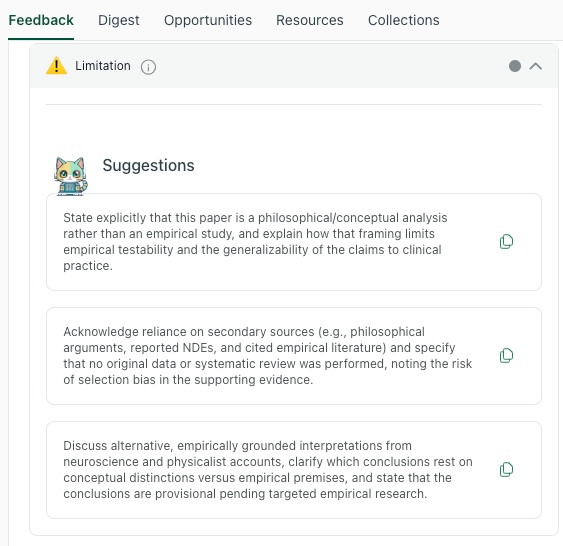
Get Section-Level Suggestions with Pre-Submission Review
Trinka: Technical Grammar and Discipline-Specific Language Correction
Use Trinka later to refine technical phrasing and journal-style language without flattening the specialist terminology your field requires.
🔍
Ready to Review?
thesify was designed by academics for academics.
By aligning with integrity standards, thesify supports your research workflow while safeguarding academic values. Log in or upgrade today to experience feedback aligned with academic standards that respects your disciplinary precision rather than flattening it.
📚
Further Reading
AI Tools for Academic Research: How to Identify What’s Actually Academic
Not all AI research assistants are created equal. An academic AI tool must support scholarship rather than undermine it. Drawing on librarian rubrics and policy guidance, the following criteria define when an AI tool deserves the “academic” label. Learn what makes an AI tool truly academic. Discover criteria for data privacy, reproducibility and integrity, plus recommended tools for academic research.
AI Proofreading Tools vs Built‑In Checkers: A Guide for Academics
Accurate proofreading is essential for journal submissions, theses and grant applications. Digital tools have become standard, but not all tools address academic needs. Learn whether AI proofreading tools like Grammarly add value beyond built-in checkers in Word and Google Docs in our evidence‑based guide for researchers.
AI Peer Review Tools: What They Actually Check Before Submission
In 2026, the best AI tools for academic peer review are split into two distinct camps: the enterprise-grade gatekeepers used by journals to screen submissions, and the proactive, author-focused coaches used by researchers to refine their work For those navigating the traditional peer review process, understanding these specialized AI tools is essential to preventing desk rejections and getting published faster.
Need more insights?
Visit our full blog archive or newsletter archive for expert advice on academic writing.
Until next time,
The thesify Team