

tW: Socratic Writing Workflow
Use "Slow AI" workflows to protect your reasoning and avoid the 17% performance drop warned by the OECD.
The Socratic Playbook: Training Your “Slow AI” Logic
The OECD Digital Education Outlook 2026 warns of a “Performance-Learning Paradox”: students using generic AI shortcuts scored 17% lower on retention assessments than those who worked independently . This “illusion of competence” signals a rise in cognitive offloading, where bypassing the “productive struggle” of reasoning prevents the development of durable expertise . This edition of thesify weekly focuses on the Socratic Method as a safeguard for scholarly rigor, shifting from “Fast AI” generation to an inquiry-based model of revision. This week’s blog post provides the full framework for protecting the “judgment layer” of your work.
This Week’s thesify Feature to Try: Chat With Theo for Socratic Questioning
Socratic revision treats your draft as a set of claims that can be tested through disciplined questioning. With Chat with Theo, you can ask document-specific questions about an abstract, opening paragraph, or key claim, then use the responses to identify missing assumptions, vague commitments, and weak links between evidence and inference.
How To Use Chat With Theo as a Socratic Partner
Step 1: Locate Chat with Theo
Open your document, then open Feedback in the right panel. Chat with Theo appears inside this panel.
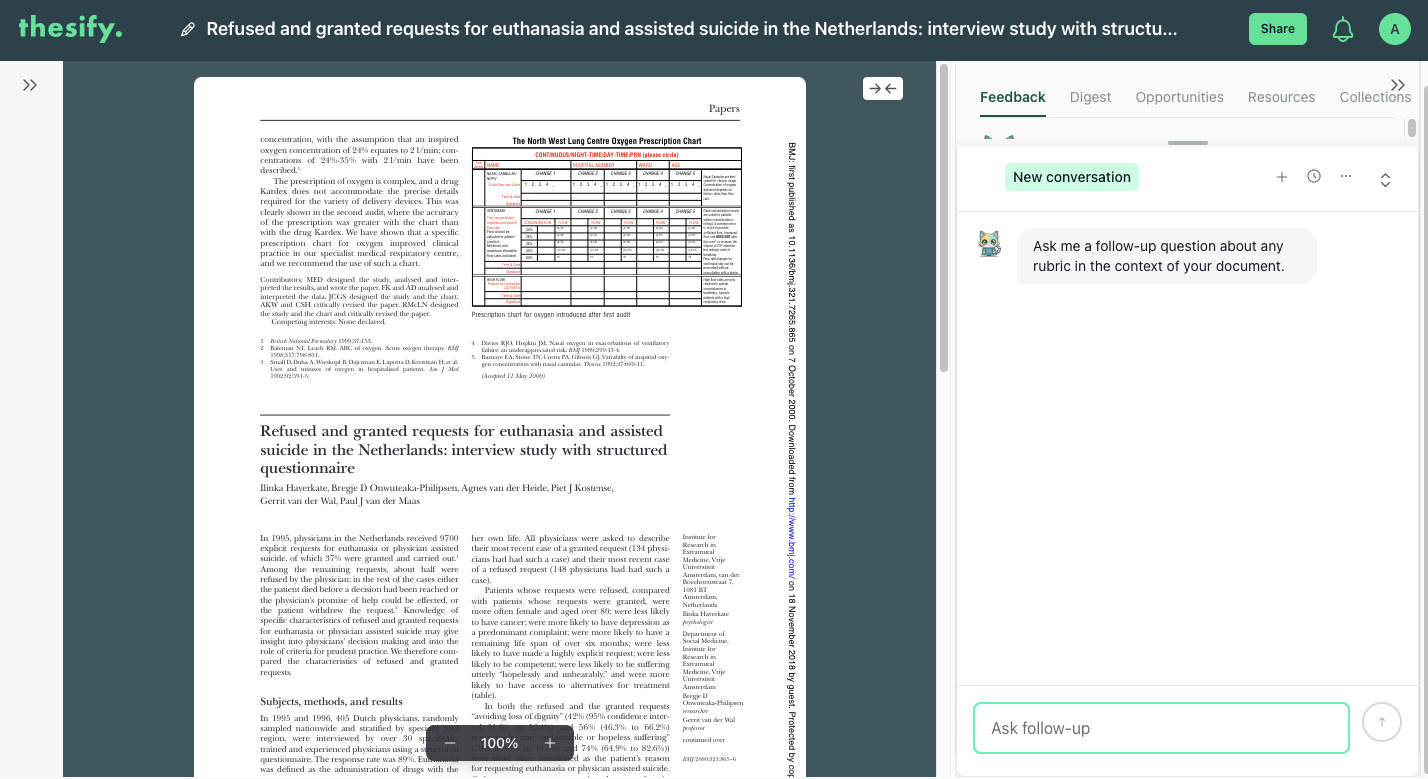
Chat with Theo sits inside the Feedback panel on the right side of your document.
Step 2: Start a New Conversation, Then Ask One Socratic Question
Click New conversation, then ask one question about one specific passage (a claim, paragraph, or section). Aim for an assumption check or a defensibility check.
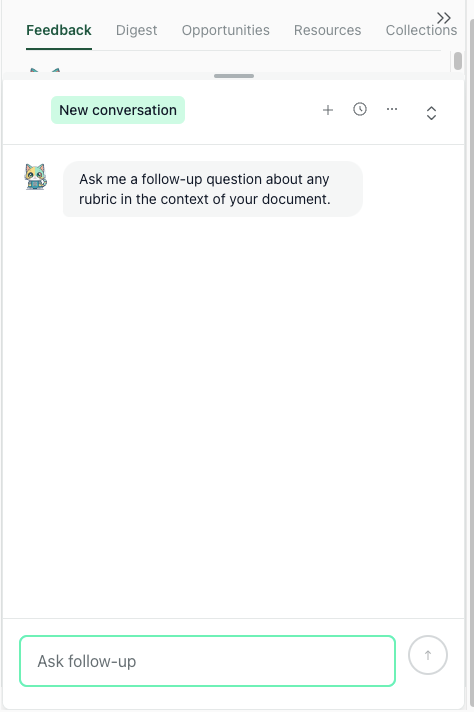
Start a new conversation and ask one question tied to a specific aspect of your draft.
Socratic Use Cases To Try Today in Chat With Theo
Use Case 1: Decidability Check (Clarity and Commitments)
Ask Theo a question that separates what your passage commits to from what it leaves indeterminate. This is especially useful for an abstract or results summary, where readers are scanning for concrete information.
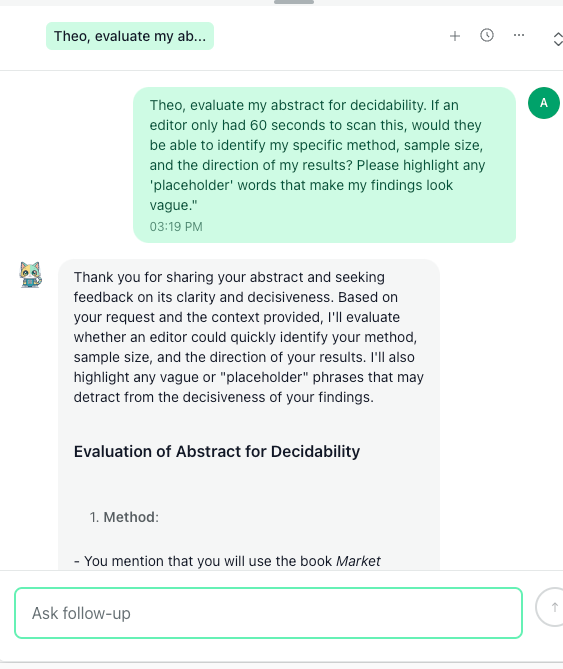
A decidability question distinguishes clear commitments from ambiguity.
Use Case 2: Opening Sentence Probe (Assumption and Stakes)
Try asking Theo, “What assumption does this first sentence ask the reader to accept, and what does it imply the paper will establish?”
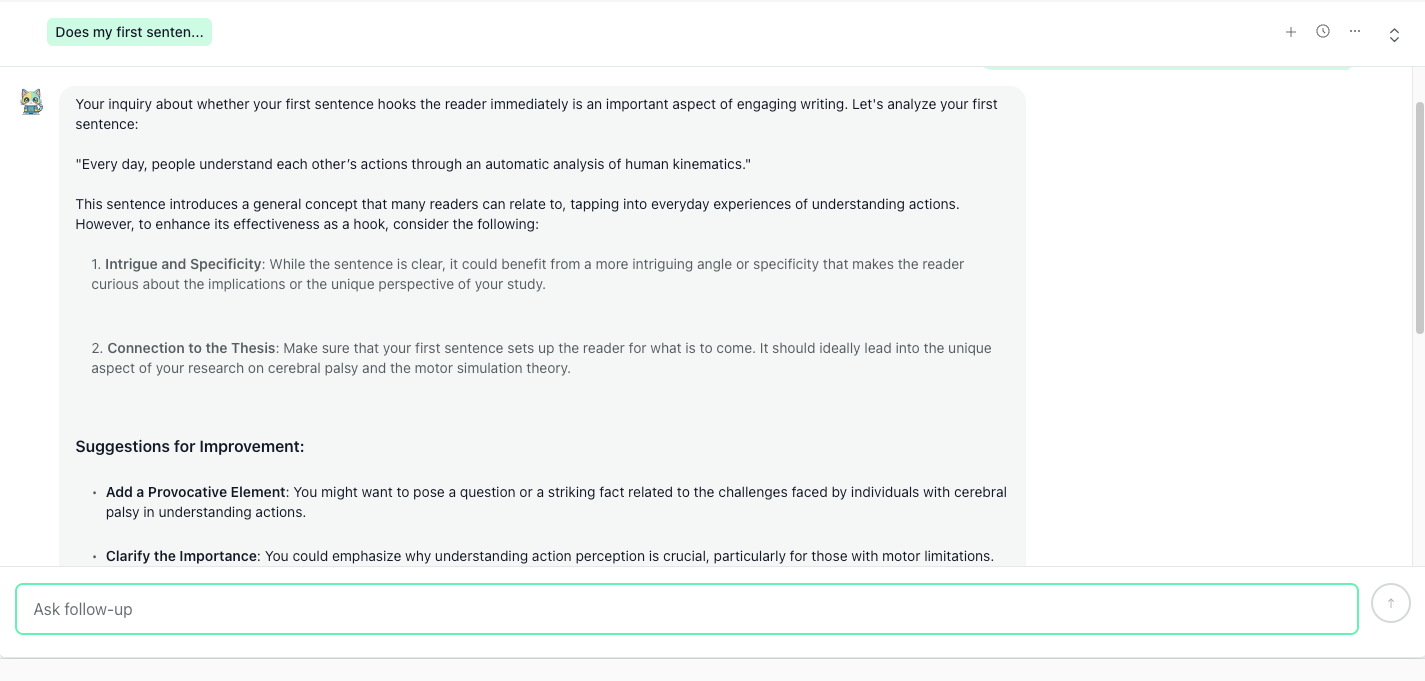
A first-sentence probe clarifies what your opening promises.
Use Case 3: One Question, One Sentence Revision (Make the Answer Explicit)
Ask Theo: “What is the single most important question this paragraph raises for a skeptical reader?”
Revision rule: Add one sentence that answers that question directly (definition, scope limit, method detail, or warrant).
Your Weekly Tips: The Socratic Revision Framework
Socratic revision is the practice of treating your own sentences as claims that must survive cross-examination. If you are staring at your draft wondering how to cross-examine yourself, checking the “Suggested Topics” in your thesify feedback is the fastest way to surface the exact questions a reviewer will ask. Before you consider a section finished, put it through these four diagnostic questions.
1) The “Negative Space” Question: What context am I ignoring?
Ask yourself: What external factors, competing perspectives, or structural realities have I completely omitted? If you are writing about a complex system, have you defined the human elements or just the timeline?
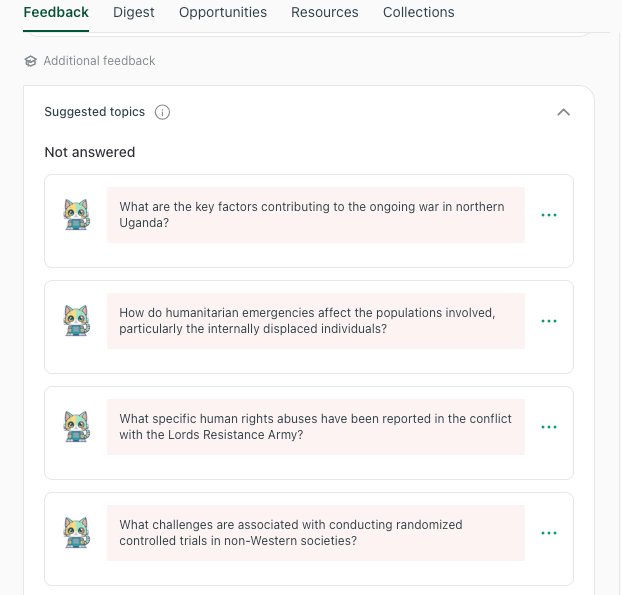
A rigorous Socratic prompt forces you to consider the specific factors missing from your current draft.
2) The “So What” Question: Am I summarizing or synthesizing?
You stated a fact. Now, force the synthesis. Ask yourself: In what specific ways does this evidence alter the broader relationship I am studying? This moves your writing past mere description and forces you to establish why the reader should care.
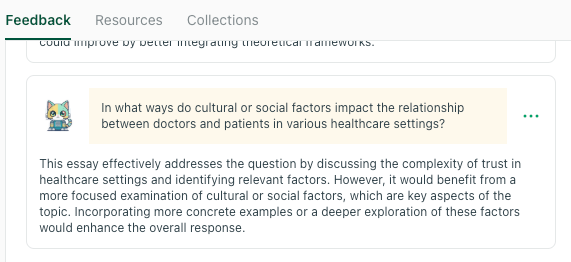
A good Socratic partner pushes you to explicitly analyze underlying variables.
3) The “Burden of Proof” Question: Am I hiding behind generalizations?
Socratic inquiry attacks broad platitudes by demanding specific mechanisms. Look at your foundational claims and ask: What exact evidence proves this is true in practice? If you state a professional environment is “complex,” a rigorous Socratic prompt will refuse to let that stand, forcing you to articulate the specific multidisciplinary challenges involved before you move on.
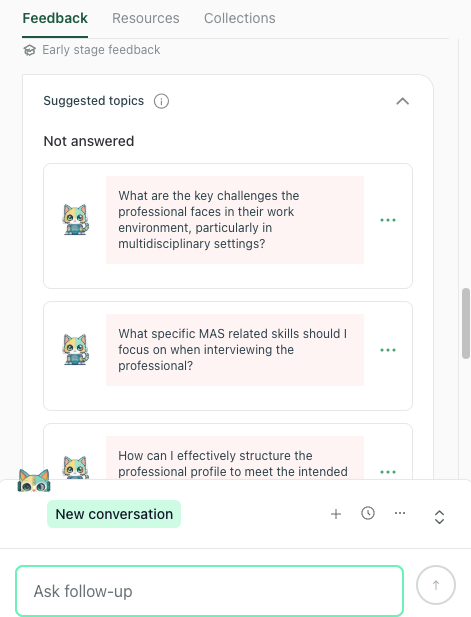
A Socratic workflow requires you to satisfy the burden of proof by defining the exact mechanisms at play.
4) The “Scope” Question: Which battles am I choosing to fight?
A crucial part of Socratic revision is managing your scope. You do not have to answer every question a reader might have. Look at the questions raised by your draft and ask: Does addressing this point strengthen my core thesis, or is it a distraction? Take control of your revision by actively deciding what to exclude.
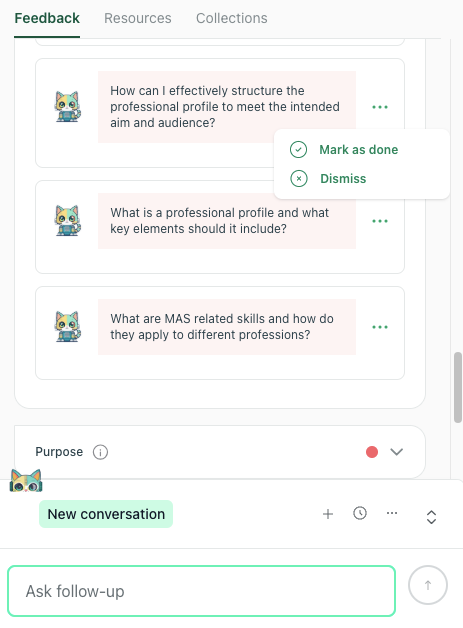
Actively curate your feedback by dismissing questions that fall outside your defined boundaries.
This Week’s Blog: Impact of Generative AI on Student Learning, An OECD Warning
The OECD’s latest warning is less about “AI is bad” and more about how AI can change what you practice when you read, take notes, and draft. This week’s blog translates the report into concrete academic writing and study scenarios, and shows what to watch for in your own workflow.
What “cognitive offloading” looks like in real drafting
Why fluent text can mask weak reasoning
Practical ways to keep your learning and argumentation intact
Related Resources
thesify Weekly Newsletter Archive: We have built a searchable library dedicated to the workflows that keep you cognitively active. From explicitly mapping the literature to stress-testing your Discussion claims, every past issue is a guide to maintaining your academic agency. Use the archive to build the hybrid human-AI skills that generic chatbots cannot replicate.
Choosing the Right AI Tool for Academic Writing: thesify vs. ChatGPT: We tested ChatGPT’s approach (“Fast AI”) compared to thesify’s approach (“Slow AI”), assessing specifically how both AI tools function for academic writers. While ChatGPT provided surface-level suggestions, its reliance on text generation often detached its feedback from the test manuscript’s academic objectives, making it less actionable. thesify, by contrast, provided ethical, detailed feedback that helped refine the thesis while improving the test manuscript’s overall coherence and academic rigor. Find out more about the key differences we uncovered in our ChatGPT vs thesify testing.
Academic Writing in the Age of AI: Rise Above AI Slop: Part two of thesify’s scientific writing series. When AI-generated prose is everywhere, polished writing is no longer a differentiator, it is often the new baseline. If your draft sounds generic, readers assume you did not do the intellectual work, even when the science is solid. Learn how to avoid AI slop, use generative AI responsibly, and keep your voice when drafting research papers.
Scientific Paper Discussion Section: How to Stress-Test Your Draft: Is your discussion just repeating results? Use thesify to stress-test your interpretation, limitations, and future research for validity. Using a rubric derived from top-tier journal standards, thesify stress-tests your draft for Interpretation of Results, Robustness of Limitations, and the Feasibility of Future Research. This post shows you how to use this feedback to ensure your arguments hold up to scrutiny.
Encourage learning without generating text
“Fast AI” often offers feedback that prioritizes convenience over meaningful academic growth or encouraging novel ideas. Avoid disconnected solutions. Upgrade today to go deeper with thesify’s guidance that promotes critical thinking and ensures academic integrity.
Need more insights? Visit our full blog archive or newsletter archive for expert advice on academic writing.
Until next time,
The thesify Team