

tW: Your Paper’s Sequel Strategy
“More research is needed” is a weak ending. Use this 3-part protocol to turn vague suggestions into a concrete study design.
The Discussion-To-Next-Paper Blueprint
In this week’s thesify weekly, you’ll try the Feasibility Check, a fast way to tighten the Future Research paragraphs of your Discussion section. You’ll learn how to replace the vague “more research is needed” boilerplate with concrete study parameters, define your target population and metrics, and avoid the “wishlist” trap that triggers reviewer skepticism. This week’s blog walks you through a practical stress-test for your entire Discussion, helping you ensure every claim is supported, calibrated, and ready for reviewers.
This Week’s thesify Feature to Try: Paper Digest’s Summary
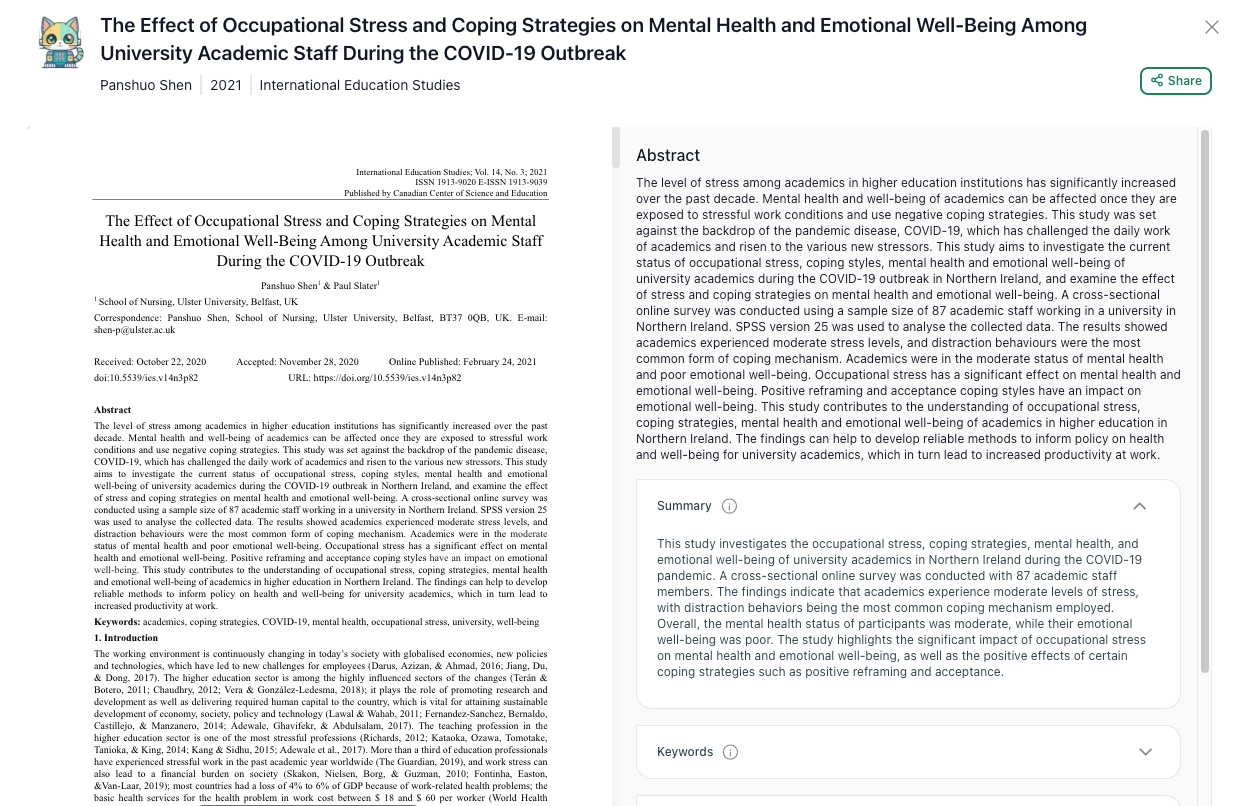
Read the summary alongside the text to quickly locate gaps in the literature.
The Challenge: Getting Distance From Your Draft
When you have been staring at your Discussion section for weeks, you lose the ability to see it objectively. Furthermore, to write a feasible “Future Research” section, you need to quickly identify the gaps in other people’s work without getting bogged down reading 50 full PDFs.
The Fix: Use Theo’s Summary tool
1. The “Mirror Test” (For Your Draft)
Upload your own manuscript to thesify, and open the Digest tab. Theo will generate a concise summary of your work.
The Test: Read the generated summary. Does it accurately capture your main argument and the limitations you thought you highlighted?
The Insight: If Theo misses your key takeaway, your reviewer likely will too. Use this to spot where your narrative thread is breaking.
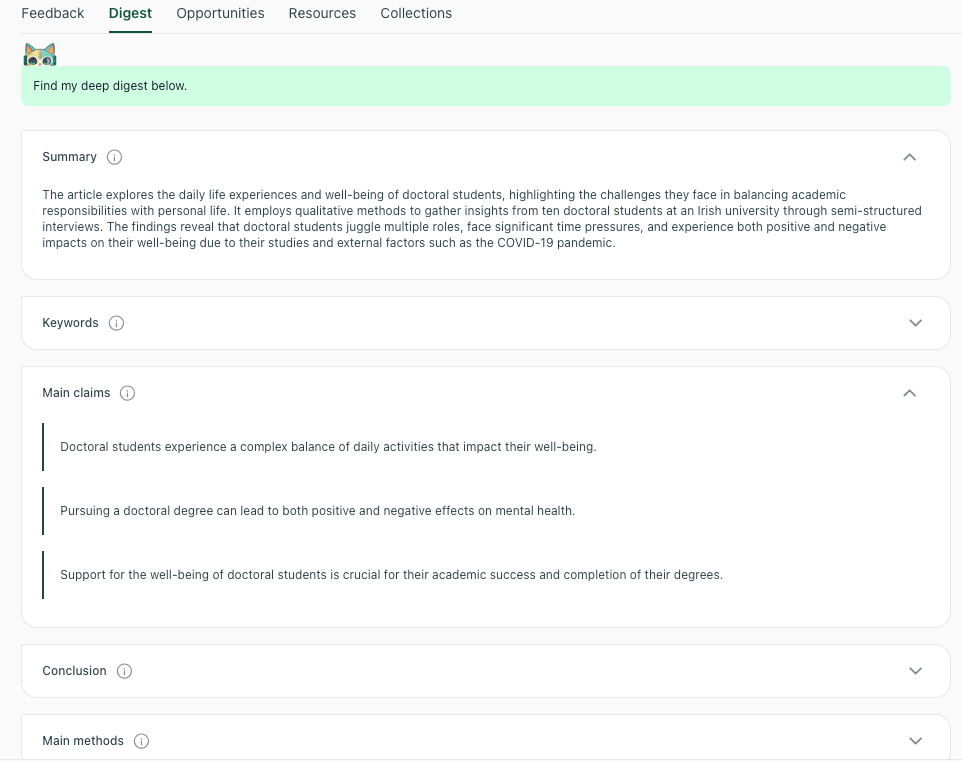
Get an objective, high-level view of your own paper to check for clarity.
2. The “Gap Hunter” (For Your Lit Review)
Use the Summary tool on other papers to speed up your search for future research angles. Instead of skimming abstract after abstract, use the summary to see the full argument, key claims, and conclusions at a glance.
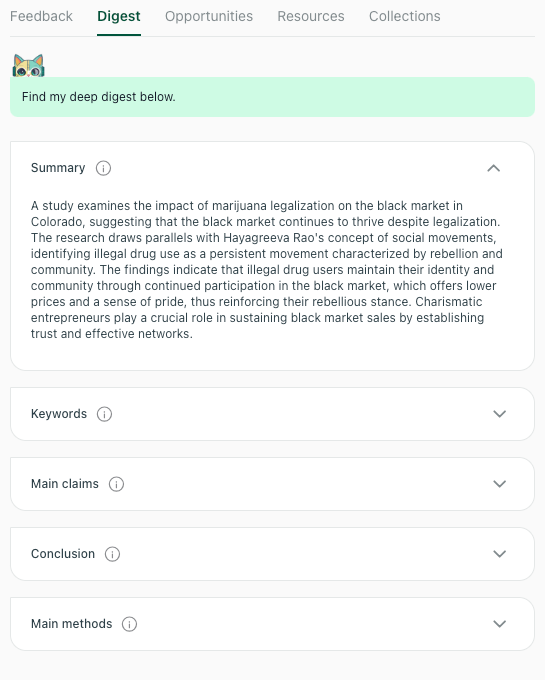
Deep summaries go beyond the abstract, connecting mechanisms and findings.
How to Use It:
Upload any manuscript in thesify as a Scientific Paper (yours or a reference paper).
Click the Digest tab.
Hover over the Summary icon or expand the dropdown to see the narrative overview.
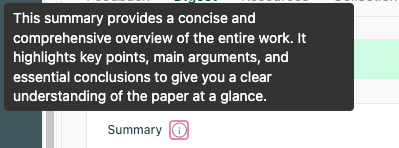
Instant context, right where you need it.
Your Weekly Tips: The Feasibility Protocol
1) Anchor Your Suggestion to a Limitation
Don’t brainstorm future research in a vacuum. The strongest suggestions solve a specific inferential problem you just named in your Limitations section.
The Move: Look at your limitations paragraph. Did you flag a lack of temporal ordering? A homogeneous sample? That specific constraint is the starting point for your next study proposal.
2) Run the “Wishlist Test”
Check your draft for vague “wishlist” sentences like “Longitudinal research is needed to explore these mechanisms”.
The Test: If you removed the topic words (like “longitudinal” or “mechanisms”), would the sentence still tell a researcher what to do next?.
The Fix: If the answer is no, you need to add operational details. Replace genre labels with specific methods (e.g., replace “further study” with “a retrospective cohort using medical records”).
3) Build the 3-Part Feasibility Spec
To make a suggestion reviewer-proof, build it around three concrete details:
Design: What specific method would answer the question? (e.g., a cluster trial, a 14-day diary study) .
Population/Setting: Who are we recruiting and where? (e.g., women presenting to primary care clinics) .
Measurement: What specific variable adjudicates the claim? (e.g., validated trust scales at baseline and follow-up) .
4) Use the “Reviewer-Proof” Template
Stuck on phrasing? Copy-paste this structure into your draft to ensure you hit all the feasibility marks:
“To address [Limitation], a [Design] study in [Population/Setting] could measure [Key Variables] to test whether [Bounded Hypothesis].”.
This Week at thesify: Meet Us at AMLD (EPFL)
thesify will be at Applied Machine Learning Days (AMLD) at EPFL in Lausanne, February 10–12. If you’re attending, come say hello and see how thesify supports faster, more defensible academic writing, from first draft to revision.
Find us at: Booth #B8
If you’re attending: stop by for a quick walkthrough and tell us what you are trying to publish next.
If you will not be at AMLD, we would still love your input. We are running a short survey to understand which writing bottlenecks cost you the most time (and what you want thesify to build next). It takes about 5 minutes, and it directly shapes our roadmap.
This Week’s Blog: Scientific Paper Discussion Feedback: Stress-Test Your Draft
The boundary between observation and interpretation is where drafts often go off track, turning weak associations into causal claims. This week’s post shows you how to “stress-test” your Discussion section by anchoring every claim to a specific result, writing limitations that are specific to your study design, and transforming vague future research suggestions into feasible protocols. Learn how to use thesify’s section-level feedback to ensure your argument never outpaces your evidence.
Related Resources
thesify Weekly Newsletter Archive: a back catalog you can actually use. If you have 15 minutes and one stubborn problem in your draft, the archive is built for that moment. Each edition focuses on a single, high-impact writing move, gives you a simple diagnostic to spot the issue fast, then walks you through the minimal fix that improves clarity and reviewer confidence. Browse by the problem you’re facing and pull one tactic at a time as you revise.
How to Audit Your Scientific Paper Results Section: The results section is the empirical heart of your research. It is where you lay your cards on the table. However, it is also one of the most difficult sections to get right. Reviewers often reject manuscripts because the results are disorganized, the statistics are opaque, or the author has drifted into interpreting the data before they have finished reporting it. Get detailed feedback on your scientific paper results section. Discover how to check for interpretation creep, missing statistics, and clarity issues with thesify.
Methods Section Review and Reproducibility Using thesify: Methods section matter for reproducible science. Methods sections were once tucked away in supplementary materials, but the push for reproducibility has reinstated them as central to research transparency. A clear methods section allows others to understand your work, evaluate your findings and, importantly, replicate your procedures. Use thesify’s section‑level feedback to improve your methods section. Learn how to document sampling, analysis and tools clearly so others can reproduce your study.
PhD by Publication Discussion Chapter: Structure & Synthesis: This article is your comprehensive resource on writing the discussion chapter of a PhD by publication. It combines authoritative guidance from university policies with actionable frameworks, examples and templates. We focus specifically on synthesising multiple papers into a coherent narrative and provide a practical workflow, checklists and troubleshooting advice. Plus, we show how to use thesify’s supportive ecosystem alongside writing an integrative discussion chapter.
Use thesify to “Argument-Proof” Your paper
Ready to submit? Don’t guess if your paper is ready. Upgrade today and upload your manuscript to thesify to check your argument structure and find the perfect journal, conference, or grant match before you hit submit.
Need more insights? Visit our full blog archive or newsletter archive for expert advice on academic writing.
Until next time,
The thesify Team